
Writing for a global audience?
Drop the sports lingo


You might know what to do if you’re advised to “quarterback a project”.
I don’t.
Growing up in Europe, I know my way around soccer, but football lingo is beyond my grasp.
Football or baseball metaphors don’t have the same emotional impact on me, but they are a favorite tool in English-language copywriting. They suggest action, drive and momentum.
As a brand or company, you may lose your persuasive force in your marketing campaigns entirely when you sprinkle in sports metaphors. Your carefully planned outreach strategy can backfire because not all readers are sports fans, even within English-speaking cultures.
If I am still confused by some sports idioms after living in New York for decades, what if you want to reach a global audience? Translating sports metaphors literally into other languages can result in the complete loss of meaning. They don’t travel well.
Every language has its own set of metaphors, even within sports.
Content that’s too referential or idiomatic will get lost in translation, sometimes literally. When it comes to sports metaphors, the challenge is even greater.
Because these phrases are highly culture-bound. They alienate or exclude those unfamiliar with any cultural, historical or political references they rely on.
So what should you do? Be direct.
Instead of…
“Step up to the plate” > take responsibility, take initiative, take action
“Drop the ball” > make a mistake, miss an opportunity
“Move the goalposts” > change the rules unfairly, shift expectations
“Hit it out of the park” > achieve great success, exceed expectations
“Quarterback the project” > lead the team, coordinate the project
From a content design perspective, these metaphors don’t just risk miscommunication. They’re exclusionary. They signal to your audience that the writing wasn’t meant for them, and that’s a missed opportunity to connect.
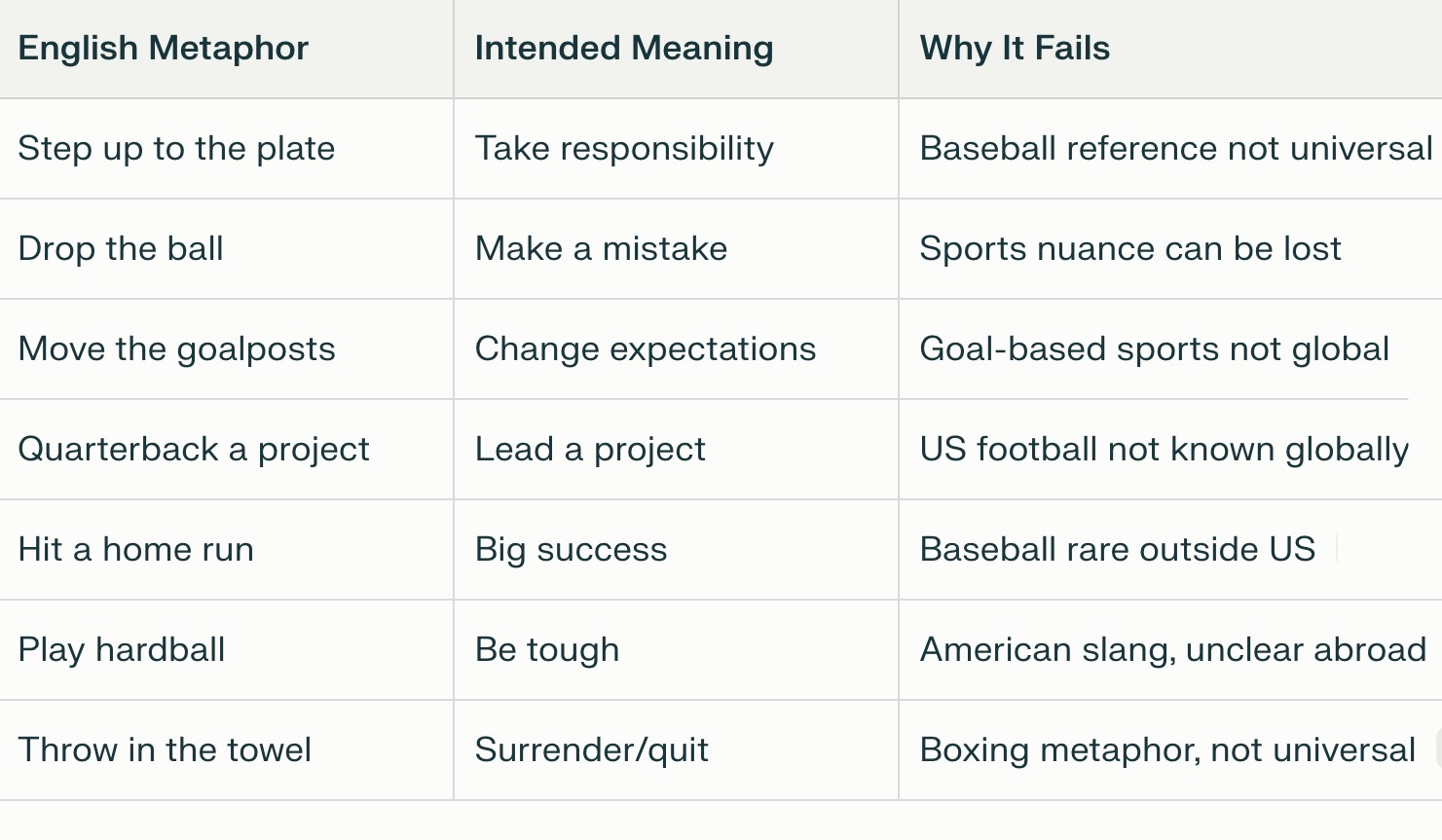
To reach a global audience (and it likely is)…
Replace or adapt sports metaphors to match the cultural and sporting context of your audience. For European or South American readers, for example, use soccer or generally shared metaphors rather than baseball or American football idioms.
Be aware of subtle differences in metaphorical understanding, cultural references, idiosyncratic nuances and idiomatic meaning.
Work with native speakers and culturally adapt writers, editors and translators to identify relevant idioms and rephrase them to retain the underlying message.
Swap metaphors for plainspoken alternatives that have the same emotional and rhetorical impact.
Write as if your words will be translated.
Bottom line: Sports metaphors can weaken your message across languages and cultures, regardless of whether you write in English or translate your content into another language. Ask yourself whether a phrase resonates with someone unfamiliar with this sport or with the English language, and then rewrite or localize it.
Only then, you’ve really hit it out of the park.
That’s all for today!